As she heads toward the finish line to wrap up her Ph.D., Gabriela Molica says her research focus began by accident. She studies oligodendrocytes — a type of glial cell in the brain and spinal cord that produces myelin, the protective sheath around neurons that helps them to communicate.
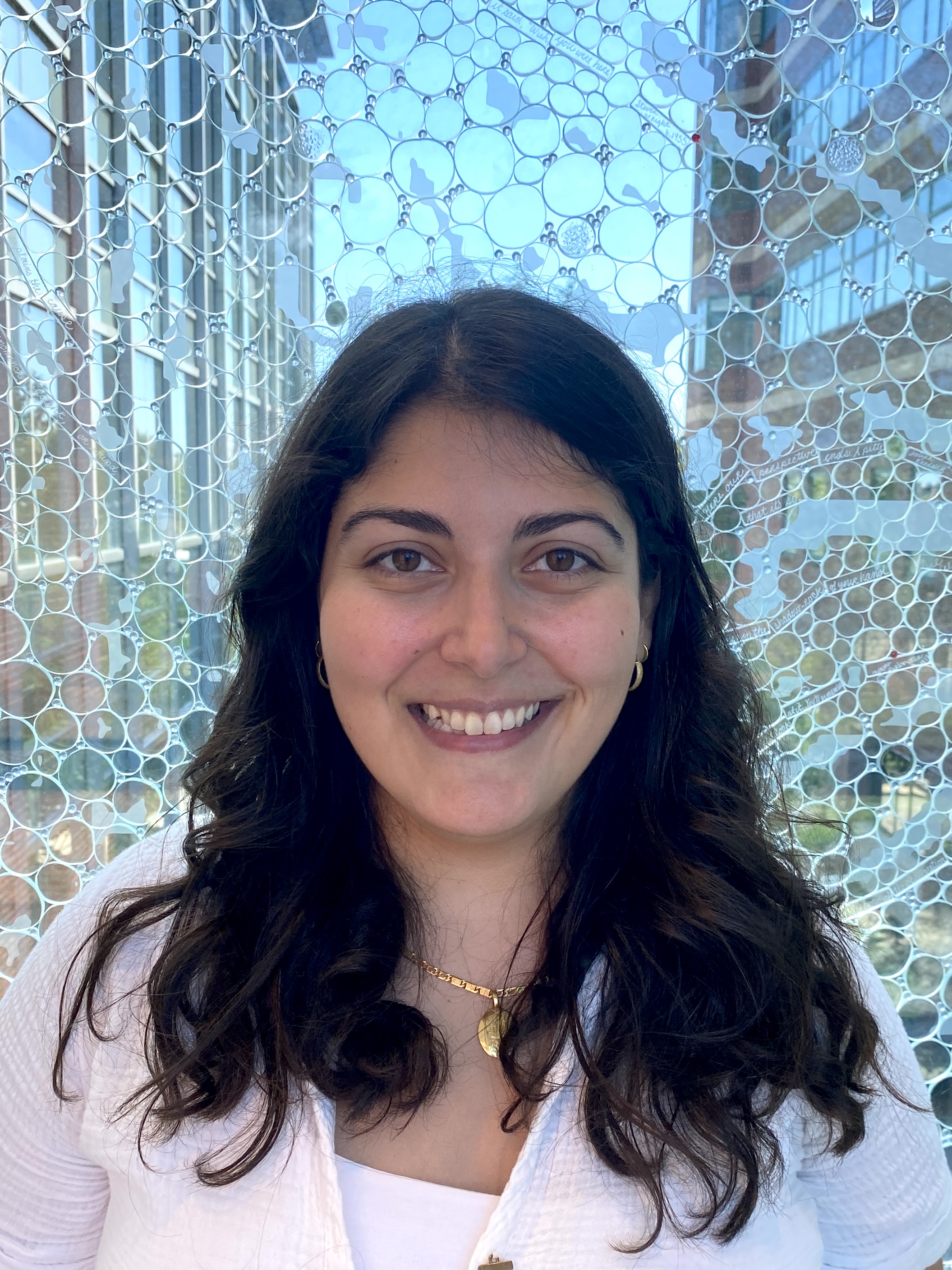 “When I was an undergraduate at UMass Amherst, I joined an alcohol drinking lab and they had this interesting project where they were interested in studying how myelin microstructure might change due to binge drinking during adolescence,” Molica said. “That really got me interested in glia, the ‘underdogs’ of the neuroscience field.”
Although glia are one of two major cell types in the nervous system, they historically have been overshadowed by neurons. Until recently, glia were believed to merely be a structural glue in the nervous system, according to Molica.
Her current research is part of an emerging effort to uncover the roles of glia, which are receiving growing attention among the scientific community.
“Gabi was already very familiar with oligodendrocytes and myelination in the CNS (central nervous system) when she joined my lab, having studied them intensively prior to entering grad school,” said Mayoral. “Her knowledge in the field has continued to grow since then and she is now even more of an expert on oligodendrocyte development.”
Mayoral’s lab aims to understand how the production of myelin impacts neuronal structure and function. While the main understood function of myelin is to wrap around neuron axons –– cell fibers that transmit information –– to speed up signaling, myelin also impacts the size of axons and their patterns of signaling. Understanding these effects can clarify the impact of disorders, such as multiple sclerosis, where myelin is damaged.
The lab also studies the role of other glial cells, such as astrocytes, in how oligodendrocytes develop. Astrocytes, the most numerous and functionally diverse glial cells, may express certain genes and proteins that influence whether oligodendrocyte precursor cells (OPCs) mature into oligodendrocytes. These findings potentially could be useful in the development of targeted therapies for multiple sclerosis and other disorders.
Molica expanded on the details of her research since beginning her PhD in 2021, her interests outside of the lab, and where she sees herself after finishing her studies at Brown.
Your work aims to uncover signaling proteins that play a role in the differentiation of OPCs into oligodendrocytes. What have you found that is unique about these signals, and what is important about these findings?
An assumption of the field is that neurons play a main role in telling oligodendroglia when to do things, such as differentiate or myelinate, at the proper time. But what’s interesting about my work is that I've identified potential signals expressed by other glia that could contribute to these processes. So we might begin to uncover that glia interacting with other glia are important relationships in these critical processes. If we can then learn how to control the way in which astrocytes express these signals, then we can maybe exploit them as therapeutics for demyelinating disorders.
In 2024, you were one of six students to be a recipient of the Carney Graduate Award. The project supported by the award is titled, “Non-neuronal regulators of oligodendrocyte differentiation in the postnatal optic nerve” — what is the aim of this work?
The aim of this project is looking for potential signals regulating oligodendrocyte development. However, we've also recently decided to ask a complementary question: how do oligodendroglia impact the development of other glia in the optic nerve? Usually the optic nerve is nearly completely myelinated by oligodendrocytes. In the lab, we have a really interesting mouse model, in which only half of the optic nerve is myelinated. I can compare normal nerves to ones that never had oligodendrocytes and myelin to understand how their presence might impact the development of other glial cells, such as astrocytes and microglia, and the vasculature.
With this, we can start to understand the important role of this specific glial cell type in shaping its local environment and any functional consequences that come from lacking such crucial cells.
What’s special about the optic nerve in studying myelination?
The optic nerve is the part of the central nervous system that brings electrical signals directly from the eye to the brain, and it’s one of the earliest structures that are myelinated during development. Since this structure is made of only axons going in one direction, it's quite easy to observe oligodendrocytes myelinating specifically in one direction in a unidirectional manner during development –– whereas in the other brain areas, there’s axons going in every direction, making it hard to track where exactly myelin is being made and when.
Due to this simplicity, we can study the precise timing of differentiation and myelination processes in the developing optic nerve. While seeing myelin is indicative of the capacity of the cells to differentiate and mature into oligodendrocytes, this proxy is flawed because not all cells survive the differentiation process. Therefore, we can also use the optic nerve as a model to begin to understand whether these processes are uncoupled or coupled.
You’ve made efforts to engage with the scientific community throughout Rhode Island, reigniting the Brown Brain Fair following its hiatus during the pandemic, and volunteering at the Pawtucket Brain Fair. What about these science outreach efforts excite you?
I really loved science and brain science for a long time, ever since I was in high school, but I never saw opportunities to learn about those kinds of things outside of a classroom. These are learning experiences that I really wish I had the opportunity to engage in as a kid, and so that’s what really drove me to want to take part in them. It was really great to interact with the whole state of Rhode Island, and I feel like the neuroscience community in the entire state is really tight-knit.
Where do you see yourself after completing your PhD?
I would love to continue doing science in any capacity, whether that means doing a postdoc or going into an industry position. I never thought I would be pursuing a PhD; the possibility didn't cross my mind until I already had several years of research experience. I came to grad school thinking it wasn't feasible for me to become a PI –– the path is very difficult and seemed almost unattainable. As I continue one step at a time, that reality seems more possible, so you never know what the future holds. I’m just going to keep moving forward and continue to do the science that makes me excited.