Robert J. and Nancy D. Carney Institute for Brain Science

Early Career Mentors

Two graduate student mentors from this year's Leadership Alliance Summer Research Early Identification Program (SR-EIP) reflect on the role of mentorship in their research careers.

Alisa Salazar 

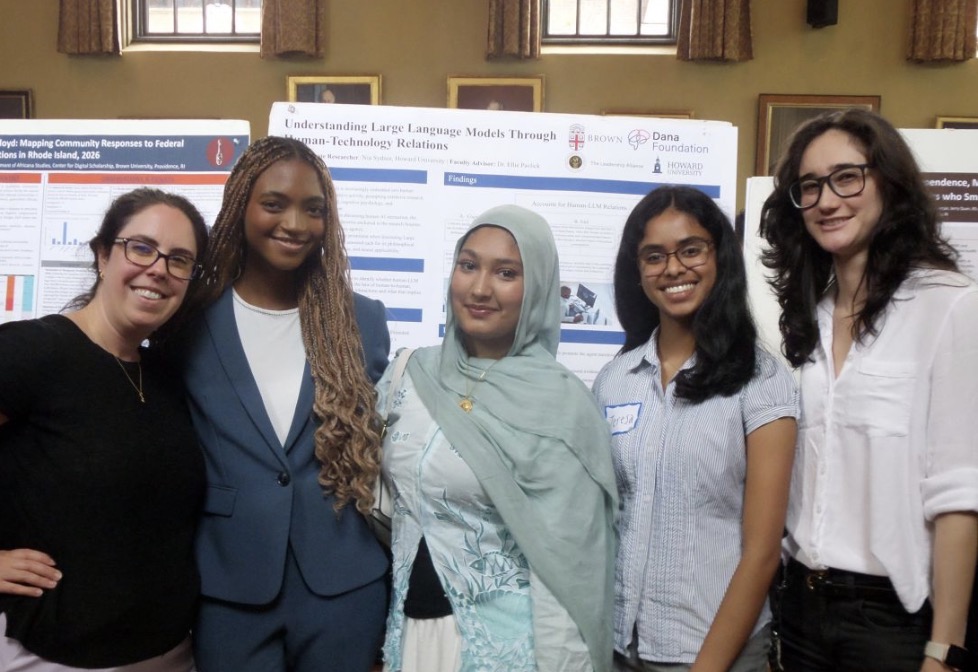
A medium shot photograph taken at a university poster session. Five smiling women are posed in front of two large research posters displayed on easels in a well-lit room with wood paneling. The group is arranged in a line from left to right. The woman on the far left is wearing a dark cardigan, glasses, and a black top. Next to her stands a woman in a blue blazer and white shirt. The central figure wears a light green patterned hijab and top. The woman fourth from the left wears a blue and white striped short-sleeve button-down shirt. The woman on the far right wears a white button-down shirt and glasses. The main poster behind them is titled "Understanding Large Language Models..." and includes the logos for Brown University, Howard University, and the Dana Foundation.
At the Brown summer research poster session with Dana cohort mentees. Left to right: Kristin Webster (Associate Director of Training and Development, Carney Institute), Nia Sydnor, Rubaiya Rahman, Teresa Pathadan, Alisa Salazar. Not pictured: Isabel Tirado Zayas, Legna Rivera, Caroline Rezende Mendes.

Studying voltage-gated calcium channels in the lab of Diane Lipscombe, Alisa Salazar notes that their collaboration began with a bit of luck. A fellow graduate student at Boston University met the “queen of ion channels” at an event and recommended that she and Salazar connect over their shared focus on calcium channel research.

“When I met Diane, it was just a really good match in mentorship style, and she was interested in a lot of the same questions,” Salazar said. 

Lipscombe, a professor of neuroscience and director of the Carney Institute for Brain Science, studies the channels within cell membranes that transport calcium into cells — triggering the release of neurotransmitters that allow neurons to communicate with each other. When these channels are disrupted, they can lead to chronic pain disorders, ALS or other conditions.  

Salazar, a fourth year graduate student, studies CaV2.1, a voltage-gated calcium channel that is encoded by the CACNA1A gene. It is primarily present in the cerebellum, a part of the brain responsible for motor function. Depending on what segments of the CACNA1A gene are expressed — a concept known as alternative splicing — variations of the Cav2.1 channel can be produced. 

“We know that alternative splicing confers different properties to the protein product, but we don’t know exactly what it does for the developing brain,” she said.

Salazar, who primarily studies the gene in mice models, says that determining the genetic profile of variations in CACNA1A gene expression — and whether they are protective or harmful — could lead the way in the development of future gene therapies. 

“I’m working with the CACNA1A Foundation to look into the mutations that are present in the human population and if there is something we can do to mitigate some of the developmental problems that arise with those mutations,” she said.

Outside of her research, Salazar has served as a mentor this past summer for Leadership Alliance's SR-EIP, a nine-week summer research internship for undergraduate students at outside institutions interested in pursuing a Ph.D. or joint M.D. and Ph.D. 

As a mentor, she met with the students once a week to support their research projects to be presented at a national symposium. She shared her experience as a mentor in the program and the value of mentorship in her own research journey. 

Why did you want to mentor? 

I love mentoring students. I’ve been very lucky to be able to mentor students in a few different contexts now, but I ultimately want to give the same support and chance to students coming into research that I had. I was very lucky that the person that primarily trained me in my undergrad lab — the first time I was ever in a lab environment — was a postdoc who’s super supportive, loves science and loves talking about all of it. 

What are you enjoying about the experience?

I get to mentor several students working on a bunch of different projects, and I get to hear the excitement that they have for all these different topics that I would normally never touch as a research scientist. I’m in a very wet lab, and I do not overlap with a lot of these students very often, but they're just a lot of fun. It’s really cool to see them engaged in research full time for maybe the first time, and it really does bring back a lot of the “oh yeah, I do remember that.” It’s valid to have these struggles or these feelings, but watching them sort it out is really cool and empowering.

What mentors have been influential in your own career? 

I have very little academic background in my family, but my mom was a professional volleyball player, so she had a lot of sports physiology background and I always loved talking to my mom about that. I think getting back into that and pushing physiology to a limit, I ended up with neuroscience and just fell in love with it, but I didn’t have a good sense of what this trajectory or any of these careers would look like. I was focused on finding something that I would love to work in for the long term. Luckily, I was surrounded by a bunch of grad students and postdocs who gave me a really good sense of what grad school was and why it could be relevant to me. I wouldn’t have been able to make this choice to start grad school without all of those people.

Why is mentorship important in research? 

I think it’s important to have those anchors, someone in grad school going through it, to know whether or not it’s right for you. A lot of these students are thinking about whether or not they want to go to grad school in the future, and it really helps to know people who are currently in it. 
From all the Brown mentors I’ve had, it’s been the collaborative nature that stands out — encouraging curiosity, being available as a mentor, pointing students in the right direction without telling them exactly what to do, and really letting them grow.

Pran Chanthrakumar Third year M.D.-Ph.D. candidate

Pranavan Chanthrakumar 

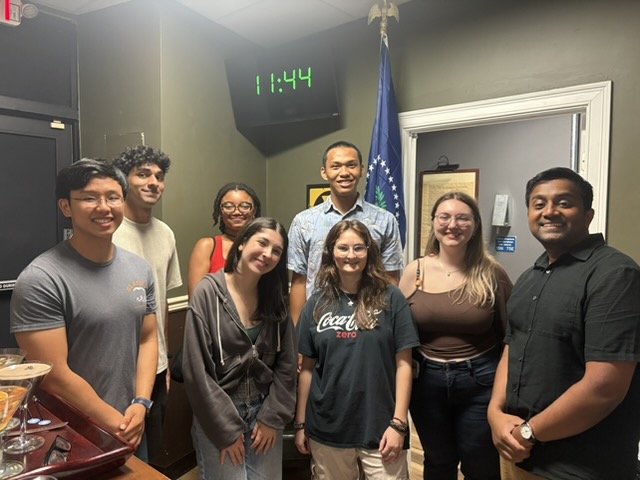
Eight people pose together indoors for a group photo in two rows. They are standing in an office or venue with olive green walls, a digital clock displaying 11:44 overhead, and a flag in the background.
Team group outing. Back row: Aarith Veerabhadran, Amani Snellings, Jinyao DeSandies. Front row left to right: Alex Xie, Alice Yacubovich, Audrey White, Vanessa Murati, Pranavan Chanthrakumar

Approximately 30 percent of people with major depressive disorders (MDD) are afflicted with treatment-resistant depression, defined as an inadequate response to at least two antidepressants. With depression cited as the largest cause of years lost of healthy life, ineffective treatments present a significant burden.

Pranavan Chanthrakumar, an M.D.-Ph.D. candidate in his third year, hopes to understand what mechanisms in the brain are responsible for these shortcomings in drug responses. 

His work makes use of a dataset available to researchers through the National Institute of Mental Health Data Archive. Called Establishing Moderators and Biosignatures of Antidepressant Response for Clinical Care for Depression (EMBARC), the dataset is a clinical trial assessing how various biomarkers correlate with the efficacy of two types of antidepressants — sertraline and bupropion. One of the biomarkers Chanthrakumar is studying includes measurements from electroencephalograms (EEG), a test to measure the electrical activity of the brain. 

“Once you look at the raw data and see if there’s differing patterns in these EEG biomarkers, we can use the lab software to test hypotheses about what’s generating those differences,” he said.

The lab’s software includes a tool called the Human Neocortical Neurosolver (HNN), a publicly available modeling tool developed by Chanthrakumar’s advisor, neuroscientist Stephanie Jones. While EEGs are a widely accessible exam to gain insight into brain activity, they lack the precision to determine what happens at the neuronal level. By developing a technology that allows the behavior of neurons to be converted into EEG activity, researchers can begin to understand the mechanism of how drug therapies for conditions including MDD work and how they can be optimized. 

“This is to address a huge problem, which is that a lot of times the treatment approach for psychiatric disorders is a lot of trial and error,” Chanthrakumar said. “The longer you go without actually getting effective treatment, the more at risk you are of not only worsening your own condition, but worsening risk for disorders of other systems, like the cardiovascular system.”

Chanthrakumar’s research interests have spanned the field of behavioral neuroscience. During the first semester of his Ph.D., he rotated in Michael Frank’s neuroscience lab and worked on a project modeling how patients with depression differed in their expression of cognitive signatures associated with decision-making, such as the tendency to avoid offers during a behavioral task. 

Following this experience, he aimed to understand the brain and behavior from a more micro level, looking at what happens on the scale of neurons. Naturally, he landed with the Jones Lab, which broadly uses computational neuroscience techniques to study the brain at the cellular level.

“The Jones lab, similar to the Frank lab, had a lot of its work centered on a core lab package,” Chanthrakumar said. “That, combined with the idea of combining different levels of understanding the brain and behavior, seemed like a really natural and complementary next step to what I had already been doing.”

Outside of his research, Chanthrakumar mentored undergraduates in the Leadership Alliance SR-EIP, a nine-week summer research internship for undergraduate students at outside institutions interested in pursuing a Ph.D. or M.D.-Ph.D. 

As a mentor, he meets with the students once a week to support their research project with the goal of presenting their work at a national symposium. In an interview with Carney, Chanthrakumar spoke about his experience as a mentor in the program, and the value of mentorship in his own research journey. 

Why did you want to mentor? 

I’ve always loved teaching. It’s been a huge part of my academic career. When I was an undergrad at Brown, I was a computer science TA for seven out of eight semesters. One thing I love about teaching is not only watching someone else learn, but it also challenges me to make sure that I understand the topic really well. I think the best way to teach is to really meet the mentee or student where they’re at, and that involves learning about approaches or perspectives you did not consider when you were learning the topic originally.

What are you enjoying about the experience?

I’ve been very impressed by their initiative, and I think with research there’s a lot of uncertainty whether that’s which direction you go in or what resources you have, or even what is out there to know. Some of these students are rising sophomores, so they’ve just finished their first year of college, and I think they’ve been handling that challenge really well. I can see as the summer has gone on, they’ve become more comfortable with uncertainty, and they’ve become more comfortable with finding those next steps that work best for them. 

What mentors have been influential in your own career? 

Obviously Dr. Jones, I love working with her. Whenever I go into a meeting with her, I leave with a lot of clarity and understanding. I’ll just have a lot of unknowns, and then I’m like, “oh, okay, this is what you get after so many years of doing science.” Dr. Frank as well, and the two postdocs I’ve worked most closely with are Nadja Ging-Jehli (in the Frank lab) and also the postdoc here that helped me get started with the EMBARC project is Darcy Waller. The other postdocs in the lab have been awesome too, so there’s Nicholas Tolley, who’s a recent graduate of the program, and there’s David Zhou. I would name them as my most topic-relevant mentors, and from each of them I’ve learned different approaches.

Why is mentorship important in research? 

In general, from all the Brown mentors I’ve had, it’s been the collaborative nature that stands out — encouraging curiosity, being available as a mentor, pointing students in the right direction without telling them exactly what to do and really letting them grow. I think a lot of scientific approach is about personality as much as it is the science, and that’s why learning how to communicate and interface with so many different people, whether it’s your students, your mentors or your colleagues is all so important.