Small Wonder
An artificial neural network that models the brain of a larval zebrafish is paired with a virtual body that interacts with a simulated aquatic environment.
By Gretchen Schrafft, Science Communication Specialist
By Gretchen Schrafft, Science Communication Specialist
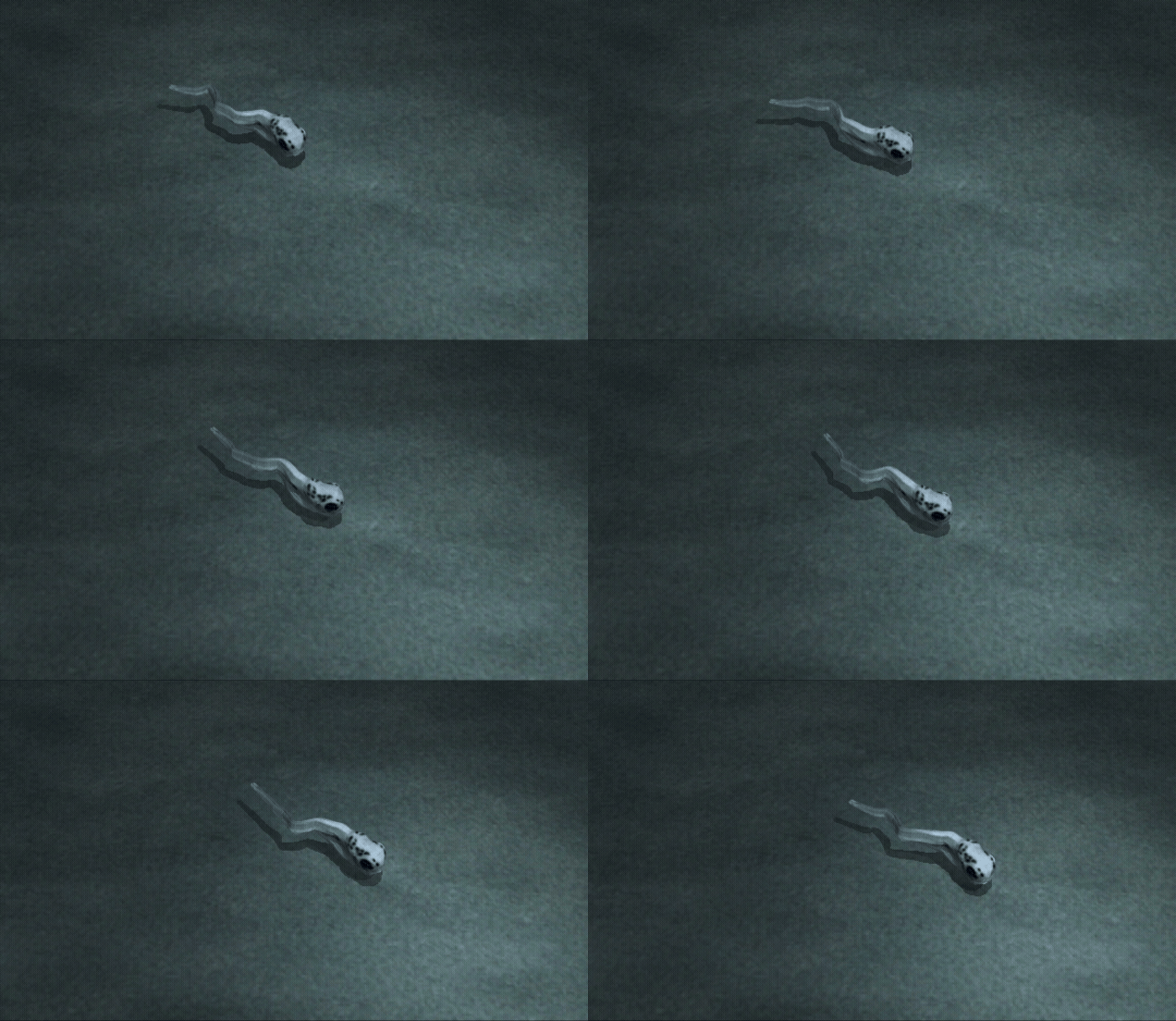
This virtual zebrafish swimming isn’t just a neat computer trick. It’s a stunning example of an embodied AI model pursuing a goal all on its own.
“To our knowledge, this work is the first embodied computational model to emulate brain behavior entirely as a result of pursuing an autonomous goal–in this case, swimming against a current–without any previous training,” said Leo Kozachkov, Howard E. Zimmerman Assistant Professor of Brain Science and Engineering, who joined the Carney Institute last fall.
“These results are a really strong argument that, to understand brains, we have to build them, and to build them, we have to embody them.”
Unlike traditional artificial intelligence that exists purely as code on a computer screen, “embodied AI” pairs an artificial neural network, or “brain,” with a biomechanical body, recognizing that a truly biologically inspired model should reflect that a human brain also exists in a body. Kozachkov and collaborators at Carnegie Mellon created an artificial neural network that models the brain of a larval zebrafish (a go-to model for neuroscientists) paired with a virtual body that interacts with a simulated aquatic environment. The body and the environment are real-world constraints informed by biology and physics that push the artificial neural network to perform behavior that matches neural recordings of real zebrafish larva.
A key aspect of the team’s zebrafish model is that the artificial neural network emulates not only the firing of neurons, but also the behavior of astrocytes, a type of glial cell that Kozachkov believes plays a key role in how the brain coordinates and performs longer and slower memory processes.
The model has furthered discussion in the science community around “digital twins,” the possibility of whether artificial animal models could replace live animal models in research.
Kozachkov is eager to continue developing his model at Brown. “I’m interested in improving the model so that it can stitch many complex behaviors together in an adaptive way.”